





Teeth Cleaning: How Often You Really Need It (And What Happens If You Wait)
Consider two people, same age, same set of healthy teeth on day one.
The first one brushes religiously. Twice a day, never misses, uses the good toothpaste. But she has not seen a dentist in eight years, because nothing hurts. Why would she go? Her teeth look fine in the mirror.
The second one is honestly a little less disciplined at home — some nights the flossing does not happen. But he goes in twice a year, every year, without fail.
Fast forward ten years. Whose mouth would you rather have?
Most people guess correctly, and then fail to apply the answer to themselves. Here is why the second person usually comes out ahead: brushing and a professional cleaning are not two versions of the same thing. They do different jobs. Brushing is what you do daily to remove soft plaque before it hardens. A professional cleaning removes what brushing already failed to catch — and no amount of diligence at home substitutes for it, because those deposits are physically beyond what a toothbrush can do.
The second thing that visit buys you is inspection. Small problems get identified while they are still small and still inexpensive to fix. That is what the first person has gone eight years without.
What a professional teeth cleaning actually is
Let’s demystify this, because “cleaning” is a soft word that undersells what is happening.
Every day, a sticky film of bacteria called plaque forms on your teeth. Brushing and flossing wipe it off. Simple enough. But plaque that hangs around starts absorbing minerals from your saliva and hardens into calculus — what most people call tartar. That process can begin within 24 to 48 hours.
Here is the part that matters: tartar is cemented on. It is not soft, it is not sticky, and it does not care how expensive your toothbrush is or how long you brush. It has to be mechanically broken off the tooth with instruments. That is the whole point of the appointment.
And tartar is not just cosmetic buildup. Its surface is rough and porous, so it grabs even more plaque, which means the problem compounds. Left alone along the gumline, that bacterial load inflames the gum tissue. Inflamed tissue pulls away from the tooth and forms a pocket. Bacteria move into the pocket where your brush definitely cannot reach. And now you are not dealing with a hygiene issue anymore — you are dealing with a disease process that eventually eats away at the bone holding your teeth in.
That is not a scare tactic. That is just the sequence. And it runs quietly. Early gum disease does not hurt, which is exactly why it wins so often.
What happens during the appointment, step by step
If it has been a while and you are dreading this, the fear is almost always worse than the visit. Here is the actual run of show.
1. The look-around
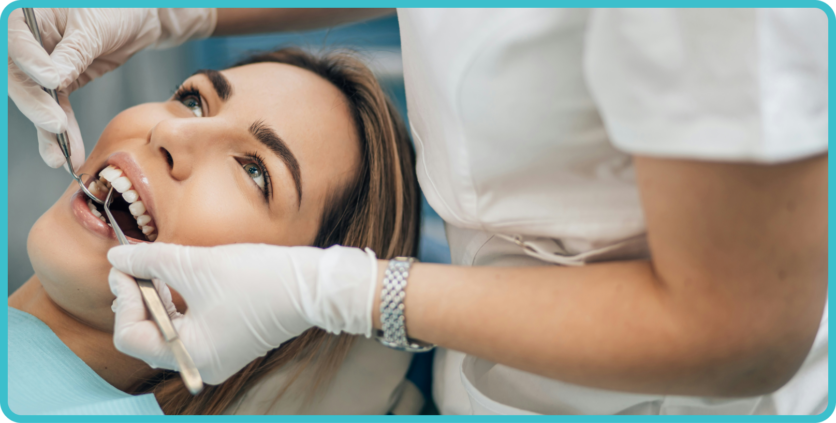
A hygienist checks your teeth and gums with a small mirror before touching anything. Depending on how long it has been and what they see, you may get X-rays. X-rays are the diagnostic scan — they show what is happening between teeth and under the gumline, which is where problems like to hide.
2. Charting your gums
This is the part people skip past, and it is the most important number in the room. The hygienist uses a small probe to measure the depth of the space between your gum and your tooth at several points. Healthy pockets measure roughly 1 to 3 millimeters. At 4mm and above, you are into territory where the pocket is deep enough that home care can no longer keep it clean on its own. Those numbers are what determine whether you need a regular cleaning or something more.
3. Scaling
The main event. Tartar gets removed from the tooth surface and just below the gumline, using either a hand scaler or an ultrasonic instrument that vibrates deposits loose while spraying water. This is where the scraping sound comes from. Here is the honest truth about that sound: the more tartar there is, the longer this takes. Patients who come in regularly are in and out. Patients who have waited five years are the ones who tell everybody the cleaning was rough.
4. Polishing
A gritty paste and a slow-spinning rubber cup smooth the tooth surface and lift surface stain from coffee, tea, red wine, and tobacco. Worth being clear about this: polishing removes stain, not deep discoloration. It cleans the surface; it does not change the underlying color of the tooth. If you want a shade change, that is whitening, and that is a separate conversation.
5. Flossing and fluoride
A professional flossing catches anything left between teeth and shows exactly where you are bleeding, which is useful information for you. Many visits finish with a fluoride treatment — a varnish or foam that helps remineralize enamel and adds a layer of protection against decay.
Start to finish, a routine cleaning generally runs 40 to 60 minutes.
Regular cleaning vs. deep cleaning: they are not the same appointment
This is where most of the confusion — and most of the surprise billing frustration — comes from. So let’s separate them clearly.
A regular cleaning, technically called a prophylaxis, is preventive. It is for a mouth with healthy or nearly healthy gums. It handles the tooth surface and the area just under the gumline. One visit, done.
A deep cleaning, technically called scaling and root planing, is treatment. It is for a mouth where gum disease is already active and pockets have formed. The hygienist works below the gumline, cleans the root surfaces, and smooths them so tissue can reattach and the pocket can shrink. Because it goes deeper, it usually involves local anesthetic, and it is frequently split into two visits — one side of the mouth at a time.
The relationship between the two is straightforward: one is what you do to avoid needing the other. Both are routine procedures, performed constantly, in every practice in the country. One is simply far less expensive and far less involved than the other.
And nobody is upselling you when they recommend a deep cleaning. That recommendation comes directly off the probing chart, and you are entitled to see those numbers. If you have 5mm and 6mm pockets, a standard polish would clean the surface of a problem that is living underneath it. The buildup that is actually causing the inflammation would still be down there when you walked out.
How often do you actually need a cleaning?
“Every six months” is so baked into American culture that most people assume it came down from a mountain. It did not. It became the standard because it was a clean, memorable interval, and it stuck.
Here is where the evidence actually sits. A large Cochrane review of adults with generally healthy gums who already see a dentist compared cleanings at six months, cleanings at 24 months, and risk-based intervals — and found little meaningful difference in gum disease or decay over two to three years. A 2023 scoping review reached the same conclusion and recommended that dental professionals make individually tailored, risk-based recommendations instead of pushing one universal schedule. The ADA’s own position is that recall intervals should be based on individual risk.
Now read the other half of that finding carefully, because this is where people get themselves in trouble. Those results apply to adults who already have healthy gums and who already go to the dentist. They are not a permission slip.
For anyone with a history of periodontal disease, the guidance runs in the opposite direction. Periodontal societies strongly recommend that supportive periodontal therapy start at 3-month intervals after active treatment, with high-risk patients continuing to benefit from that 3-month schedule and lower-risk patients staying stable somewhere in the 6 to 12 month range.
So the real answer is a range, and where you land depends on your risk:
- Every 3 to 4 months — history of gum disease, diabetes, smoking or vaping, heavy tartar builder, pregnancy, dry mouth from medication, immune conditions.
- Every 6 months — the reasonable default for most adults, and the interval most dental insurance plans are built around.
- Every 9 to 12 months — genuinely low-risk adults with clean probing depths, no bleeding, no decay history, and consistent home care.
Pro tip: ask your hygienist for your probing numbers at your next visit, and ask how many sites bled. Those two figures tell you more about the interval you personally need than any general rule ever will. If nothing bleeds and nothing is above 3mm, you are running clean. If a dozen sites bleed, you are overdue no matter what the calendar says.
One more note on interval, since a lot of people wait on insurance to tell them when to come: kids need cleanings too, on roughly the same schedule, and the first visit should happen around the first birthday or when the first tooth comes in.
The warning signs you should not ignore
Gum disease is quiet in its early stages, but it is not silent. It gives you signals. The problem is that every one of them is easy to explain away, and most people do exactly that.
- Your gums bleed when you brush or floss. This is the big one. Healthy gums do not bleed when you clean them. “I just brushed too hard” is the most expensive sentence in dentistry.
- Persistent bad breath. Not morning breath, not the garlic from lunch. Breath that comes back no matter what you do usually means bacteria are living somewhere your brush is not going.
- Gums that look puffy, red, or shiny. Healthy gum tissue is firm and pale pink, and it hugs the tooth.
- Teeth that look longer than they used to. That is recession — the gumline is migrating, and exposed root surface is softer than enamel and decays faster.
- New sensitivity to hot or cold. Often the first thing people notice, and often tied to recession or a cavity forming.
- Any tooth that feels like it moves. Adult teeth do not move. If one does, that is bone loss and that is urgent.
- A bad taste, or gums that ache. Do not wait this one out.
If you are reading that list and quietly recognizing yourself in two or three items, that is not a reason to feel bad. It is a reason to go. The visit gets easier the sooner you take it.
Why this stops being just about your teeth
About 42% of U.S. adults 30 and older have periodontitis, with roughly 7.8% having the severe form. That is not a rare condition. It is one of the most common chronic conditions in the country, and it is almost entirely preventable.
Gum disease is also a chronic inflammatory condition that lives in tissue with a rich blood supply, and researchers have spent two decades documenting its associations with cardiovascular disease, diabetes, and pregnancy outcomes. The direction of causation is still being worked out, and anyone who tells you a cleaning prevents heart attacks is overselling it. But treating a persistent bacterial infection in your head is a good idea on its own merits.
And there is the money. A cleaning is the cheapest appointment in the building. A deep cleaning costs several times that. A crown costs many times that. An implant is a different universe entirely. Every step you skip makes the next step more expensive. Cost of being wrong goes up over time — it always does.
Home care that actually moves the needle
A cleaning resets you to zero. What you do in the months in between determines how much has accumulated by the time you come back.
Brush two minutes, twice a day, with fluoride toothpaste. Two full minutes. Almost everyone thinks they do this and almost nobody actually does — time yourself once and you will be surprised. Angle the bristles at about 45 degrees toward the gumline and use small circles rather than sawing back and forth.
An electric brush helps, modestly. A Cochrane review found powered toothbrushes reduced plaque by about 11% in the short term and 21% after three months of use, with gingivitis down about 6% and 11% over the same periods. That is a real, measurable edge — but notice it is an edge, not a transformation. Technique still beats hardware.
Clean between your teeth every day. A toothbrush reaches roughly three of the five surfaces of a tooth. The two it misses are exactly where cavities and gum disease start. Floss, floss picks, interdental brushes, a water flosser — the research supports interdental cleaning generally, and the best tool is the one you will actually use daily. If you hate floss, do not fight it. Buy interdental brushes and move on with your life.
Do not rinse with water right after brushing. Spit and leave it. Rinsing washes the fluoride off before it has had time to work. This one costs nothing and almost nobody does it.
Watch how you snack, not just what. Every time you eat, your mouth turns acidic for a stretch. Sipping a soda over three hours is far worse for your enamel than drinking the whole thing in ten minutes.
If you use tobacco or vape, know the math. Nicotine constricts blood flow in the gums, which means the bleeding warning sign gets masked. Damage advances while the alarm is disabled.
If you have not been in a long time, read this part
The single most common reason people put off a teeth cleaning is not cost and it is not time. It is embarrassment.
People stay away for three, five, ten years, and every year that passes makes the door heavier, because now they are worried about being lectured on top of everything else.
Nobody in a dental office is shocked by your mouth. Hygienists see the full range every single day, and the ones worth their license are interested in one thing: what we do next. There is no version of this where waiting another year improves your position.
And if the obstacle has been scheduling — the six-week wait, the appointment that has to happen at 10am on a Tuesday when you are supposed to be at work — that is exactly the problem The Dental Walk-In Clinic was built to solve. We take walk-ins at both our Tampa and Pinellas locations. You do not need to plan your cleaning a month out. You can come in.
Keep brushing. But brushing was never the whole job.
Frequently Asked Questions About Teeth Cleaning
How often should you get your teeth cleaned?
Most adults do well with a professional teeth cleaning every six months, but the right interval depends on individual risk rather than a universal rule. People with a history of gum disease, diabetes, or tobacco use often need cleanings every three to four months, while genuinely low-risk adults with healthy gums and no decay history may be fine at nine to twelve months. The American Dental Association recommends that recall intervals be tailored to the individual. The most useful guide is your own periodontal chart: if your probing depths are 3mm or less and your gums do not bleed, you are on a good schedule.
How long does a teeth cleaning take?
A routine dental cleaning typically takes 40 to 60 minutes, including the exam, scaling, polishing, flossing, and fluoride. Add roughly 10 to 15 minutes if X-rays are being taken. If you have significant tartar buildup or have not been seen in several years, the appointment will run longer, since removing hardened deposits is the most time-consuming part. A deep cleaning (scaling and root planing) takes longer and is often split across two visits, one half of the mouth at a time.
Does a teeth cleaning hurt?
A routine teeth cleaning is not usually painful. Most people describe pressure, vibration, cold water spray, and some scraping sensations rather than pain. Discomfort tends to scale with how much tartar has built up and how inflamed the gums are — inflamed tissue is tender and bleeds easily, so people who wait years between visits report more discomfort than those who come regularly. Tell your hygienist before you start if you are anxious or have sensitive teeth; topical numbing gel and desensitizing products are available, and local anesthetic is standard for deep cleanings.
What is the difference between a regular cleaning and a deep cleaning?
A regular cleaning (prophylaxis) is preventive care for healthy or nearly healthy gums, and it removes plaque and tartar from the tooth surface and just below the gumline in a single visit. A deep cleaning (scaling and root planing) is a treatment for active gum disease: the hygienist cleans below the gumline and smooths the tooth roots so inflamed tissue can reattach and periodontal pockets can shrink. Deep cleanings usually involve local anesthetic, are often split into two appointments, and cost more. The decision between them is based on measured pocket depths, not preference — pockets of 4mm and deeper generally indicate that a regular cleaning will not be enough.
Can you remove tartar at home?
No. Once plaque hardens into tartar, it bonds to the tooth surface and cannot be removed by brushing, flossing, mouthwash, or any over-the-counter product. It must be mechanically removed with dental instruments by a professional. Tartar-control toothpastes can slow new tartar from forming, but they do not dissolve what is already there. Avoid at-home scaler tools sold online: without training and a mirror-and-light setup, it is easy to scratch enamel, injure the gum tissue, and push bacteria deeper into the pocket while leaving the actual deposits behind.
How much does a teeth cleaning cost without insurance?
In the United States, a routine cleaning without insurance generally runs about $75 to $200, with a new-patient visit that includes an exam and X-rays typically landing in the $150 to $350 range. Scaling and root planing is priced per quadrant of the mouth and commonly runs $150 to $400 per quadrant, so a full-mouth deep cleaning is substantially more. Prices vary by region and by practice. Most dental insurance plans cover two routine cleanings per year at or near 100%, since preventive care is far cheaper than the restorative work it avoids. Call ahead for exact pricing.
Why do my gums bleed when the hygienist cleans my teeth?
Bleeding during a cleaning is a sign of gingival inflammation, which is caused by bacterial plaque sitting along the gumline. Healthy gums do not bleed when they are cleaned. It is not caused by the hygienist being rough, and it is not a reason to clean that area less — the opposite is true. In early gingivitis, bleeding usually resolves within one to two weeks of consistent daily brushing and interdental cleaning once the tartar has been removed. If bleeding persists beyond a few weeks of good home care, it may indicate periodontitis and should be re-evaluated.
Will a teeth cleaning whiten my teeth?
A cleaning removes surface stain from coffee, tea, red wine, and tobacco, so teeth often look noticeably brighter afterward — but it does not change the natural color of your enamel or dentin. Polishing is stain removal, not whitening. If your teeth are intrinsically yellow or have darkened with age, you need a bleaching treatment, either in-office or with take-home trays. A good sequence is to have the cleaning first and whiten afterward, since bleaching agents work more evenly on a clean tooth surface.
Do I need X-rays with my teeth cleaning?
Not at every visit. X-rays show decay between teeth, bone levels, and problems below the gumline that a visual exam cannot detect. Typical intervals are bitewing X-rays every 12 to 24 months for adults with low decay risk, and more frequently for people with active decay or gum disease. A full-mouth series or panoramic image is usually taken for new patients or every three to five years. Modern digital X-rays deliver a very low radiation dose. If you have had recent images taken elsewhere, request them so they do not need to be repeated.
Can I get a teeth cleaning without an appointment?
Yes, at practices set up for it. Most dental offices are appointment-only and schedule hygiene visits weeks in advance, which is the main reason routine cleanings get postponed indefinitely. Walk-in dental clinics keep availability open for same-day patients. The Dental Walk-In Clinic accepts walk-ins for cleanings, exams, and urgent dental problems at both its Tampa and Pinellas, Florida locations. Availability on any given day depends on how many patients are already being seen, so calling ahead can save you time, but you do not need a scheduled appointment to be seen.
Sources
- Eke PI, Thornton-Evans GO, Wei L, et al. Periodontitis in US Adults: National Health and Nutrition Examination Survey 2009–2014. Journal of the American Dental Association. 2018;149(7):576–588.
- Amarasena N, Luzzi L, Brennan D. Effect of Different Frequencies of Dental Visits on Dental Caries and Periodontal Disease: A Scoping Review. International Journal of Environmental Research and Public Health. 2023;20(19):6858.
- Matthews DC, Al-Waeli H. Benefits of Dental Scaling and Polishing in Adults: A Rapid Review and Evidence Synthesis. JDR Clinical & Translational Research. 2025.
- Yaacob M, Worthington HV, Deacon SA, et al. Powered versus manual toothbrushing for oral health. Cochrane Database of Systematic Reviews. 2014;(6):CD002281.
- Association of Interdental Cleaning Frequency With Tooth Loss and Self-Rated Oral Health: A Cross-Sectional Study. International Dental Journal. 2025. doi:10.1016/j.identj.2025.03.012
- Lertpimonchai A, Rattanasiri S, Arj-Ong Vallibhakara S, et al. The association between oral hygiene and periodontitis: a systematic review and meta-analysis. International Dental Journal. 2017;67(6):332–343.